


Worth knowing
- An explicit table of stake and payout caps for individual Originals.
- Detailed asset/network guidance and document requirements.
- Recurring reward timing is documented rather than left as a generic VIP claim.
The trade-offs
- The public entry displayed a UK availability restriction during capture.
- A 1× deposit-wagering condition applies before withdrawal.
- A published VIP guide has a tier-label inconsistency that should be checked in the account.
Shuffle review: the important distinctions
Shuffle is most interesting to a reader deliberately comparing its Originals with outside studio games. Its public help material is also detailed enough to expose differences that a short casino profile misses: stake caps are not payout caps, tokens have network-specific support, and rewards have status and claim conditions.
The international product is the subject of this review. During our public capture it displayed a United Kingdom availability restriction; we did not bypass the notice or open a funded account. Publicly readable documentation does not establish that a reader is permitted to register from their country.
Our assessment therefore rests on the published rules and their practical implications. It does not contain a paid ranking, a measured withdrawal time or a promise of a personal reward. The useful comparison is the particular Original or studio title and the complete payment route the eligible account actually supports.
The public entry and country access
The browser capture shows an availability notice over the international site and names the United Kingdom. It is evidence of the public access result on 13 November 2026, not an illustration of a playable signed-in lobby. The notice was preserved rather than removed to make the site look available.
This matters because an international crypto brand can publish payment guides for several markets while restricting others. A Canadian banking article, for example, is not evidence that a British or Swedish visitor can use the same product. Market access, asset support and promotional eligibility are separate questions.
For a restricted reader, the access rule decides the comparison before a game list or VIP benefit does. For an eligible reader, the documentation below identifies the next account conditions to understand. We have not independently certified a licence for each reader’s jurisdiction or treated access to the help centre as a substitute for that check.

Originals and the rules of Blackjack
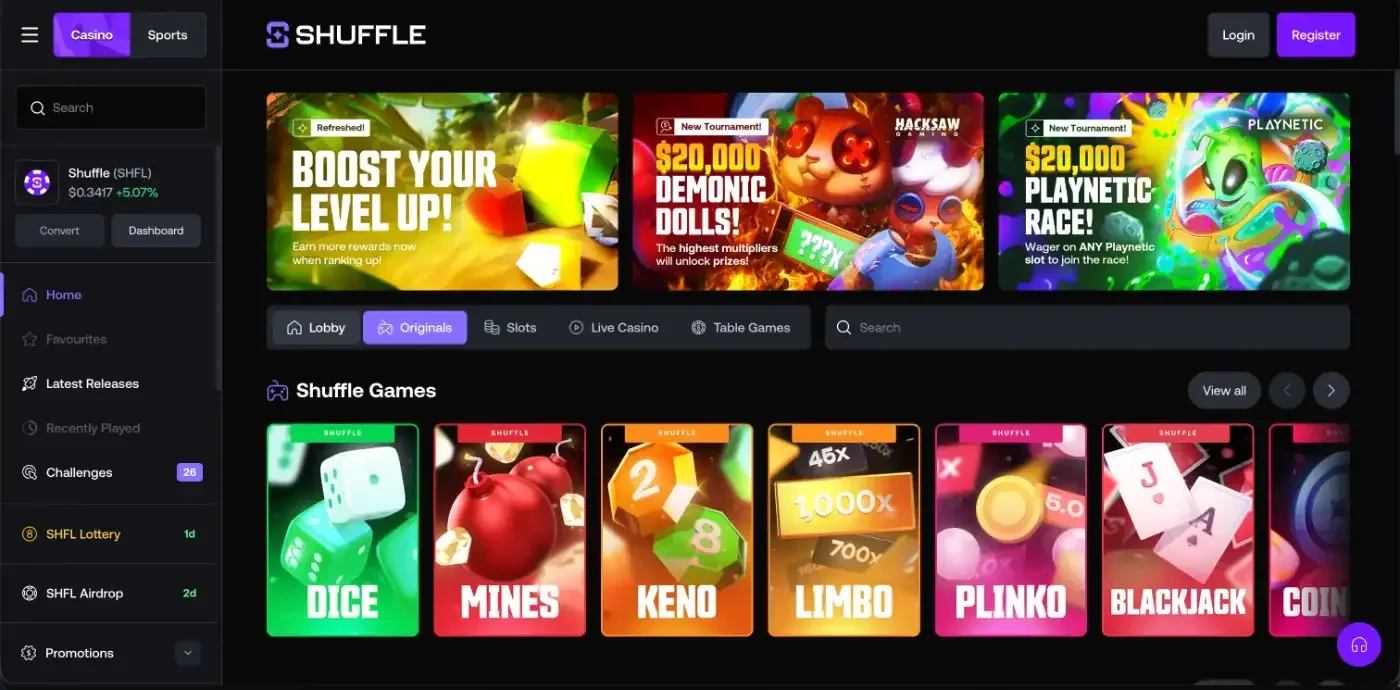
Shuffle publishes a separate rules page for its Original Blackjack. It describes infinite decks, a dealer standing on 17, a 3:2 blackjack payout, doubling rules and restrictions on splitting. The side bets have separate paytables and stated house edges. Those are concrete differences to compare with another version bearing the same game name.
The main bet and a side bet should not be treated as one proposition. A large advertised side-bet payout does not describe the return of ordinary blackjack, while the dealer and split rules affect the game a reader is actually choosing. The source is a rules document; we have not measured a session return or certified an implementation.
Third-party slots remain a different catalogue. Their provider, configured return and bonus rules need the exact game’s information panel. An Original’s verification method or betting limit does not automatically apply to a studio title. This is why the review avoids a single casino-wide RTP or one maximum stake for every game.
Maximum stake and maximum payout are different limits
Shuffle’s Originals table publishes both figures. The selected examples below are USD amounts in the current help guide, checked on 13 November 2026. They are not a recommendation to use high stakes or a personal account quote.
The guide also describes how caps affect execution. For most games, a stake and multiplier combination exceeding the payout cap is prevented. Crash and Stonks are described differently: the wager can be placed and the result is automatically cashed out at the cap. That is a game-rule difference, not simply a larger or smaller number.
A theoretical multiplier should therefore be read alongside the payout ceiling. Multiplying the largest displayed stake by the largest possible multiplier can produce a result the game will not actually permit. The table is useful precisely because it separates those constraints.
| Original | Maximum stake | Maximum payout |
|---|---|---|
| Dice | $20,000 | $250,000 |
| Mines | $20,000 | $500,000 |
| Plinko | $10,000 | $1,000,000 |
| Crash | $10,000 | $250,000 |
| Limbo | $15,000 | $200,000 |
| Stonks | $10,000 | $100,000 |
Supported assets and blockchain networks
The supported-assets guide lists BTC, ETH, stablecoins and other currencies, with explicit network support for several tokens. A token appearing in that list does not mean every blockchain carrying that token is accepted. The article warns about unsupported transfers and includes a specific supported USDC contract on Arbitrum.
That makes an asset-only payment comparison incomplete. The sending wallet, the selected receiving network and the cashier’s current instructions must describe the same route. A record such as USDT is less informative than a record pairing the token with its supported chain.
The asset list is a dated operator reference rather than a live wallet quote. We have not sent a transfer, verified recovery of an unsupported asset or independently checked a smart contract. The source link is retained so the network and address conditions can be inspected in full instead of replaced with a broad claim that all crypto works.
Deposit verification and the one-times wagering condition
Shuffle’s deposit guide requires verified email and basic-information verification before a deposit. It also warns about incorrect network transfers and destination tags. Those conditions are separate from a later document review.
The coin-mixing policy adds an account rule: deposited funds must be wagered once before they can be withdrawn. Its stated purpose is to prevent the account being used to move funds between addresses without meaningful game activity. This applies to the deposit, independently of an acquisition bonus.
That distinction changes a useful comparison. Declining an offer does not, by itself, establish that deposited money is free of account conditions. Likewise, completing a basic profile is not a guarantee that no further verification will be requested. The review separates those steps rather than treating a crypto cashier as an anonymous payment relay.
Withdrawals, fees and a Canadian banking example
Shuffle’s crypto withdrawal guide explains selecting the currency and destination and says the blockchain fee is deducted from the withdrawal amount. It also warns that blockchain transfers are final. A displayed account balance is therefore not enough to identify the exact amount that will reach an external wallet.
The Canadian-dollar guide gives a separate regional example: Interac deposit and withdrawal methods, prior-deposit conditions and Level 2 verification for withdrawals. That is useful evidence for Canada, but it is not a European bank-payment promise. We have not combined the crypto and Canadian time estimates into one casino-wide withdrawal speed.
For research purposes, separate balance eligibility, the operator’s processing and the receiving wallet or bank. A request still inside the account and a transfer already visible on-chain need different explanations.
Level 2 documents and what the guide actually accepts
The September 2026 Level 2 article accepts a passport, national identity card, driving licence or residence permit. It requires readable colour photographs showing the whole document, with both sides where applicable and at least three months of remaining validity. It rejects screenshots and digital-format documents.
Those criteria help explain a rejected submission more clearly than a generic statement that KYC is easy. The quality, validity and form of the evidence are distinct requirements. An electronic image of an accepted type can still fail the stated format rule.
The finding is the existence of an explicit document checklist and the account’s ability to request Level 2. Any review calling the service permanently no-KYC would omit that material condition.
VIP tiers, XP weighting and recurring rewards
Shuffle’s guide describes more than 50 progression levels. It states one XP per US dollar of casino wagering and three XP per dollar for eligible sports, esports and novelty bets at odds of at least 1.1. Selected tiers include Silver at 10,000 XP, Gold at 100,000 and Platinum at 450,000.
Recurring benefits include rakeback, daily and weekly bonuses, reloads and monthly bonuses. The published guide describes daily eligibility using Bronze terminology while its displayed threshold list starts with Silver. We have not invented a missing Bronze threshold to reconcile that label inconsistency. An account’s current programme screen needs checking for the exact tier and claim.
Our assessment is that the rules explain why equal stakes on different products do not necessarily produce equal progress. They do not establish the value of a personalised future bonus. A tier is a turnover milestone, not a spending goal or a guarantee that losses will be offset.
| Item | Published reference |
|---|---|
| Casino progression | 1 XP per US$1 wagered |
| Eligible sports progression | 3 XP per US$1; odds condition applies |
| Silver | 10,000 XP |
| Gold | 100,000 XP |
| Platinum | 450,000 XP |
Our assessment and the pending partner offer
Shuffle’s most useful public information is the combination of explicit Original-game caps and detailed payment instructions. The trade-offs are also specific: a deposit-wagering rule, possible identity checks, market restrictions and programme wording that is not perfectly consistent.
No Dead Lucky acquisition offer is confirmed. This page does not borrow another publisher’s code or turn a documented reward into a negotiated deal. For an eligible reader, the sensible comparison is the actual game rule set and complete payment process. For someone excluded by the market rule, rewards and game variety do not make the international product an available choice.
Shuffle questions, answered
Does a maximum payout equal the largest stake multiplied by the largest multiplier?
Not necessarily. Shuffle publishes separate payout caps and explains that a combination above the cap can be prevented or handled differently in specified games. Read the game-specific cap rather than multiplying unrelated headline figures.
Can I deposit and immediately withdraw without playing?
The published coin-mixing policy describes a one-times deposit-wagering requirement. This is an account funding condition rather than a Dead Lucky promotion rule.
Does the crypto list confirm every network for a listed token?
No. The asset guide lists supported network combinations and warns against unsupported transfers. The current cashier instructions and receiving network are material parts of the payment route.
Are screenshots of identity documents accepted for Level 2?
The guide asks for original photographed documents and expressly rejects screenshots and digital-format documents. It also gives validity and legibility conditions.
Sources and review notes
Updated 13 November 2026. The selection follows the supplied shortlist and later owner additions. Payment summaries are researched regional examples, with supporting references and unresolved conflicts identified. No funded-account, deposit or withdrawal test is included. Listed order follows the shortlist, without editorial scores.
- Operator website in the supplied roster
- Originals stake and payout limits
- Supported assets and networks
- Shuffle’s public entry displayed a United Kingdom availability restriction during our 13 November 2026 capture. The notice was not bypassed.
- Original Blackjack rules
- Deposit and basic-verification instructions
- Coin-mixing and deposit-wagering policy
- Withdrawal fees and process
- Canadian-dollar deposits and withdrawals
- Level 2 identity requirements
- Shuffle VIP programme