


Worth knowing
- Detailed public withdrawal-fee and game-limit guides.
- Originals have a separate fairness explanation.
- Product-specific exclusion and daily, weekly or monthly loss controls are documented.
The trade-offs
- Stake.com’s prohibited-territory list includes Lithuania and the UK.
- VIP status is tied to wagering, not a guaranteed cash return.
- No confirmed Dead Lucky offer; no funded-account testing.
Stake review: the decision in brief
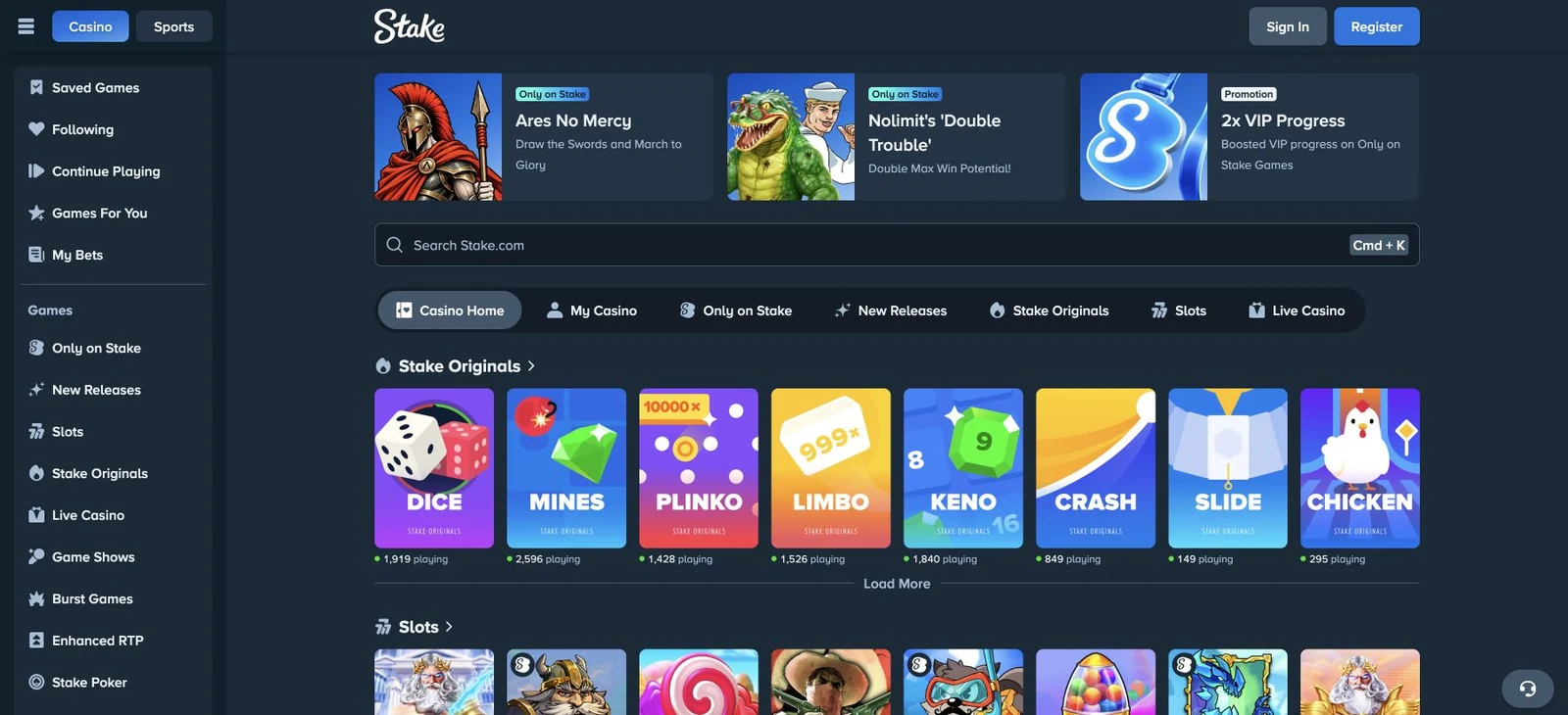
Stake is strongest as a comparison for readers who specifically want its Originals alongside slots from outside studios. The site puts those games under one brand, but their mechanics, betting limits and verification methods are not interchangeable. The most useful research starts with the game and the account’s payment route, rather than a welcome headline.
Our main finding is the amount of product-specific documentation available. Stake publishes separate guidance for third-party limits, crypto withdrawals, identity documents, VIP progression and account controls. That lets us describe concrete conditions instead of assigning a score to an account we have not funded. The rest of this review separates operator statements from our interpretation of what they mean for a reader.
Country access comes first. This review concerns stake.com, not a different regional or social-casino product bearing the Stake name. It is an information page for adults researching the operator, not an assertion that the service is available in every country. The dated source links below let you inspect the particular rule behind each finding.
Operator, licence statement and restricted countries
Stake’s terms identify Medium Rare N.V. as the operator and report Curaçao Gaming Authority licence OGL/2024/1451/0918. That is the operator’s published statement. We have not independently certified the licence or established that it authorises service in a reader’s own jurisdiction.
The same terms explicitly prohibit stake.com use from numerous territories, including Lithuania and the United Kingdom. A brand’s activity elsewhere is not evidence that this international domain accepts those locations. We did not try to bypass the security verification encountered while visiting its public casino page.
This distinction changes the comparison immediately for a reader in an excluded territory: the international product is not an available choice under its own terms. Research into a similarly named local product needs the operator, domain and local rules of that product. Combining those records produces a misleading review, especially for payments and promotional eligibility.
Originals, slots and live casino: three different checks
The key division is between Stake Originals and games supplied by other studios. Stake links a dedicated provable-fairness explanation for its Originals. That is a route to understanding how a supported game’s results can be checked; it is not a certification of every slot or live table on the site.
For studio games, Stake’s own guide says most minimum stakes fall around $0.10–$0.20, with exceptions by title and provider. It does not give one average maximum stake. Instead, the game menu shows the applicable upper limit. A comparison that assigns a single maximum to the entire casino would conceal that variation.
The distinction matters when a player has one specific slot in mind. The relevant evidence is that title’s menu and rules, not a provider logo somewhere else in the lobby. For live play, the table variant and side-bet paytables need their own reading. We have not counted the current catalogue or verified the games offered to an eligible local account, so no changing game total is presented as a fact.
Dead Lucky’s Nolimit City games you can play free are separate from an operator account. They let you examine mechanics without sending funds. Their presence here does not establish that Stake offers the same title, settings or bonus-buy options in the country version you would use.
Crypto deposits and local-currency routes
Stake’s Mesh guide describes a crypto-deposit integration. The important point for comparison is the route used to fund the account: an integrated transfer, a direct wallet transfer and a local-currency payment are different processes. A balance displayed in a currency does not identify which of those processes the account supports.
Its Canadian bank-withdrawal guide gives a useful regional example. It requires identity verification for the first withdrawal and says the receiving method should previously have been used for a deposit. Those are Canadian instructions, not proof of a bank route for a European visitor. We retain the region because removing it would turn a narrow fact into a broad promise.
If a conventional bank or card payment is essential to the comparison, confirm the actual regional product before spending time on the crypto features. The question is not simply whether a currency symbol appears in a wallet. It is whether the eligible account supports the intended deposit and withdrawal methods, in that currency, under the applicable conditions.
Published withdrawal minimums and fees
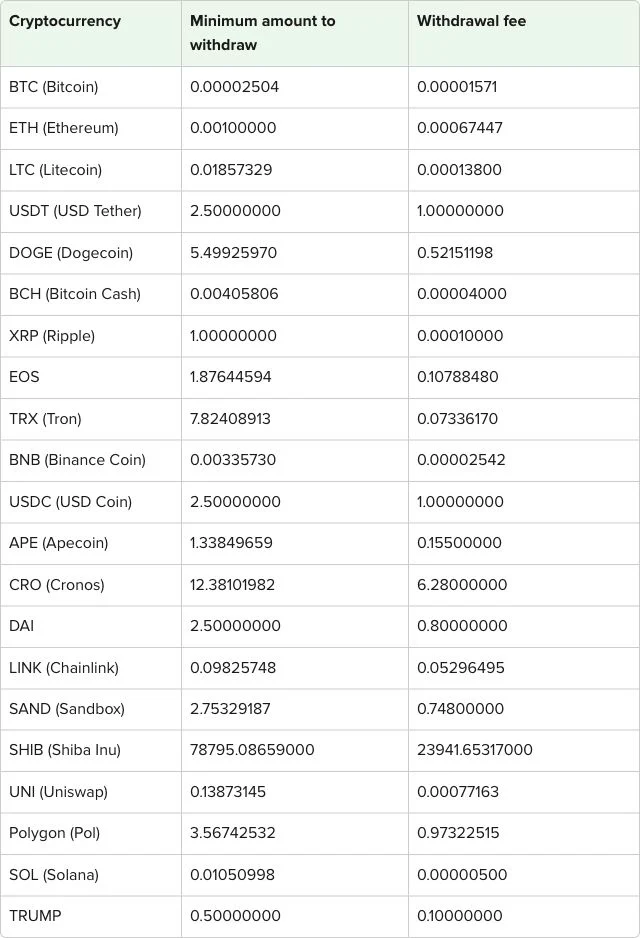
Stake publishes asset-specific withdrawal minimums and fees. The figures below are examples from the help table checked on 13 November 2026; they are denominated in the named asset and are not a live quote. The guide directs readers to the current wallet screen for the applicable minimum.
The cost of a small transfer can be quite different from the apparent cost of a larger one because the fee is quoted separately from the requested amount. Compare what will leave the balance with what the receiving wallet is expected to get. A table of network fees is also not a currency-conversion quote.
The help article states that there is no maximum withdrawal restriction within that guide’s crypto scope. That should not be expanded into a promise that every balance is immediately withdrawable or exempt from account review. Game payout limits, available balance and payment limits answer different questions.
| Asset | Minimum withdrawal | Published fee |
|---|---|---|
| BTC | 0.00002504 BTC | 0.00001571 BTC |
| ETH | 0.001 ETH | 0.00067447 ETH |
| USDT | 2.5 USDT | 1 USDT |
| USDC | 2.5 USDC | 1 USDC |
| SOL | 0.01050998 SOL | 0.000005 SOL |
The withdrawal flow and security checks
The crypto withdrawal instructions begin with verified email access, then ask the player to select a currency and network and enter the destination and amount. Confirmation may use a two-factor code, an email code or OAuth verification. These are published instructions, not steps we completed with real funds.
There are separate failure points in that flow. A login problem is not a blockchain delay; an account confirmation request is not the same as a sent transfer; and a wallet receiving the wrong asset or network is a different problem again. The guide’s separation of network selection and address entry is therefore material, rather than just interface detail.
Keep that distinction when reading withdrawal-speed claims. The time an operator takes to review or approve a request and the time the network takes to confirm delivery cannot be collapsed into one guaranteed number. We have no measured Stake payout time to add to this review.
Identity and address verification
Stake’s identity guide accepts a passport, a national identity card or a driving licence, with both sides where applicable. It requires a clear colour photograph of the original document, showing the whole document, and says screenshots or digitally created document images are not accepted. The document must remain valid for at least three months.
Address evidence follows a different guide. Examples include utility bills, bank statements, certain official letters and tenancy documents; the guide rejects mobile-phone bills, purchase receipts and medical bills. It asks for documents issued within six months and a visible full name, address, issuing entity and issue date.
The practical distinction is that proof of identity and proof of address are separate requirements. Possessing one does not establish that the other will be accepted. These published lists are more useful than describing Stake as anonymous or asserting that verification always finishes in a particular number of minutes.
VIP progression, recurring rewards and the cost of chasing a tier
Stake’s current VIP guide has substantially more levels than the short tier summaries repeated by some review pages. It gives a Bronze entry threshold of $10,000 in qualifying wagering and lists progression through Silver, Gold, Platinum, Diamond and Obsidian levels. Sports activity has a different progression weighting.
The programme lists weekly boosts, rakeback, reloads and monthly offers. Those are conditional rewards attached to activity and status, not a fixed return on money deposited. The guide describes different delivery routes and timing for different reward types. A reader should distinguish an earned status from an amount already available to withdraw.
Our assessment is that the programme is relevant to someone comparing rewards on activity they already intended to undertake. It is a poor basis for setting a gambling budget. A threshold measures turnover, which can involve repeatedly risking the same money, and does not describe the amount of loss needed or the value of a future personalised reward.
| Tier | Published qualifying-wager threshold |
|---|---|
| Bronze | $10,000 |
| Silver | $50,000 |
| Gold | $100,000 |
| Platinum I | $250,000 |
| Diamond I | $25,000,000 |
| Obsidian | $1,000,000,000 |
Deposit offers and the Dead Lucky offer status
No Stake promotion has been agreed for Dead Lucky readers. We therefore publish no bonus code, deposit match or claim link. An offer or code published by another review site does not establish a Dead Lucky campaign.
A future offer needs more than a headline amount: an eligible country and product, the qualifying deposit, the balance used to calculate wagering, excluded games, maximum stake, expiry and withdrawal treatment. The article can describe a documented loyalty programme now while keeping a separate, unconfirmed acquisition offer pending. Those are different editorial and commercial records.
Loss limits, wager limits and product exclusion
Stake documents daily, weekly and monthly loss and wager limits. Setting or reducing a limit takes effect immediately; increasing it has a 24-hour cooling-off period. A wager limit caps total stakes, while a loss limit relates to losses over its period. Those are different controls, even if the chosen amounts look similar.
Product exclusion is also separate from whole-account self-exclusion. The published tool can block Casino or Sportsbook for a selected period while leaving other account functions available. The guide lists 24-hour, seven-day, 30-day, 90-day and indefinite options, and says a fixed exclusion cannot simply be reversed before it ends.
An important boundary is that blocking Casino does not also block Stake Poker under this tool. A reader needing a broader break should use the control matching that purpose rather than assuming one product switch closes all access.
Support, mobile access and our research limits
The public help centre is organised into account, payments, casino, sports, promotions and loyalty topics. That organisation makes it possible to check a rule without signing into a funded account. It also allows a precise support query: a payment question can name the asset, network and transaction stage, while a game issue can identify the title and round.
We also did not treat a public guide’s availability on a phone as proof of the reliability of real-money mobile play. Those are separate tests. The screenshots attached to this review identify whether they show the public site or an operator-published guide, and include a retrieval date.
The useful conclusion from the research is specific: Stake publishes detailed game and payment rules, but the international domain is restricted in several major markets and its rewards depend on turnover. For a reader excluded by the terms, the access restriction decides the comparison. For an eligible reader, the exact game, transfer route and account conditions remain the points to compare.
Stake questions, answered
Is this the same product as Stake.us?
No. This review concerns stake.com and its published international terms. A similarly named social or regional product needs a separate assessment of its operator, currency model and eligibility. Do not use one product’s payment or licensing information to describe the other.
Does Stake have one maximum stake for every slot?
Its third-party game guide says the maximum varies by title and provider and is shown inside the game. There is no single casino-wide average maximum in that guidance. Check the exact version’s menu rather than applying an Original’s limit to a studio slot.
Are crypto withdrawals free?
The published help table gives asset-specific withdrawal fees. The examples in the payments section are a dated reference, not a live wallet quote. The current selected asset and network should be checked before confirming a transfer.
Can a VIP tier tell me the value of my next bonus?
A tier threshold describes progression. It is not a guaranteed cash amount for the next personalised reward. Stake lists different recurring reward types, and the actual eligible claim needs its own conditions.
Sources and review notes
Updated 13 November 2026. The selection follows the supplied shortlist and later owner additions. Payment summaries are researched regional examples, with supporting references and unresolved conflicts identified. No funded-account, deposit or withdrawal test is included. Listed order follows the shortlist, without editorial scores.
- Operator website in the supplied roster
- Third-party game limits
- Crypto withdrawal instructions
- Stake terms
- Originals fairness information
- Mesh deposit integration
- Canadian bank withdrawals
- Crypto withdrawal limits and fees
- Identity documents
- Address documents
- VIP levels and rewards
- Loss and wager limits
- Product exclusion